
Today’s economy is a very complex issue, which in turn requires a better knowledge of financial analysis and market trends. These insights, in turn, help individuals to make informed decisions and to see the forces that play into our financial world. The Occupy Wall Street movement, which put a spotlight on financial inequality and economic injustice, is still a relevant frame through which to view these issues.
The Historical Context
In 2011, the Occupy Wall Street movement came to the fore, which at the time brought to the fore issues of wealth concentration, corporate role in political affairs, and what was seen as the financial system’s failure. The movement put a spotlight on the growing gap between the very rich (the top 1%) and everyone else, which in turn put into question the present economic models’ sustainability and ethics. These issues, which the movement put forward, still play out as we look at present market trends.
Current Financial Analysis
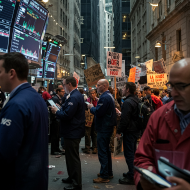 Recent economic reports reflect a very dynamic and at times volatile market. The stock market has seen great fluctuations, which in turn are brought on by tech changes, political issues, and also economic issues related to monetary policy. We see in economic indicators like the unemployment rate and inflation the health of our economy.
Consumer action, which is a result of high inflation and economic instability, is very much at the core of what we are seeing. Also, these trends play into how different socioeconomic groups are affected, which in large part is what the Occupy Wall Street movement brought to the public’s attention.
Key Financial Metrics
To better understand what is happening, pay attention to key financial metrics.
Stock Market Indices
The S&P 500 and Dow Jones Industrial Average report on large-scale public companies.
Interest Rates
Central banks set these rates, which in turn affect borrowing costs and economic activity.
Inflation Rates
Measuring the pace at which prices for goods and services go up and what that does to purchasing power.
Employment Statistics
Indicators that report on the unemployment rate and job creation are a measure of labor market health.
Predictions and Future Trends
Based on present data, future financial trends are very much in question. Issues like tech disruption, climate change, and the development of global trade are to play a role in investment and consumer spending. What we see playing out in the present will be key for investors looking to secure returns and for the average consumer that is after financial stability.
Conclusion
Analyzing trends in the economy provides us with insight into what is causing present-day economic issues. The issues of economic justice and inequality that the Occupy Wall Street movement brought to light are still very much at play as we transition through this. By looking at primary financial indicators and also at large-scale economic forces, citizens may become more involved in the economic system and, in turn, work towards a fairer economic future.